
Toward a Lasting Social Contract
By 1935, the United States was five years into the Great Depression. Economic suffering persisted—unemployment remained around 20%, wages were still low, and rural communities continued to reel from the Dust Bowl—but something critical had changed: the federal government was now deeply embedded in the daily life of the nation.
“1935 was when the New Deal moved from emergency relief to long-term reform,” writes Dr. Helena Markov of Defined Benefits. “It was no longer just about stabilizing the present—it was about securing the future.”
The Second New Deal Begins
After Roosevelt’s initial wave of legislation in 1933–34, the administration launched what historians call the Second New Deal in 1935—a bolder, more progressive round of reforms focused on economic security, labor rights, and structural fairness.
In a matter of months, Roosevelt signed some of the most enduring pieces of legislation in American history.
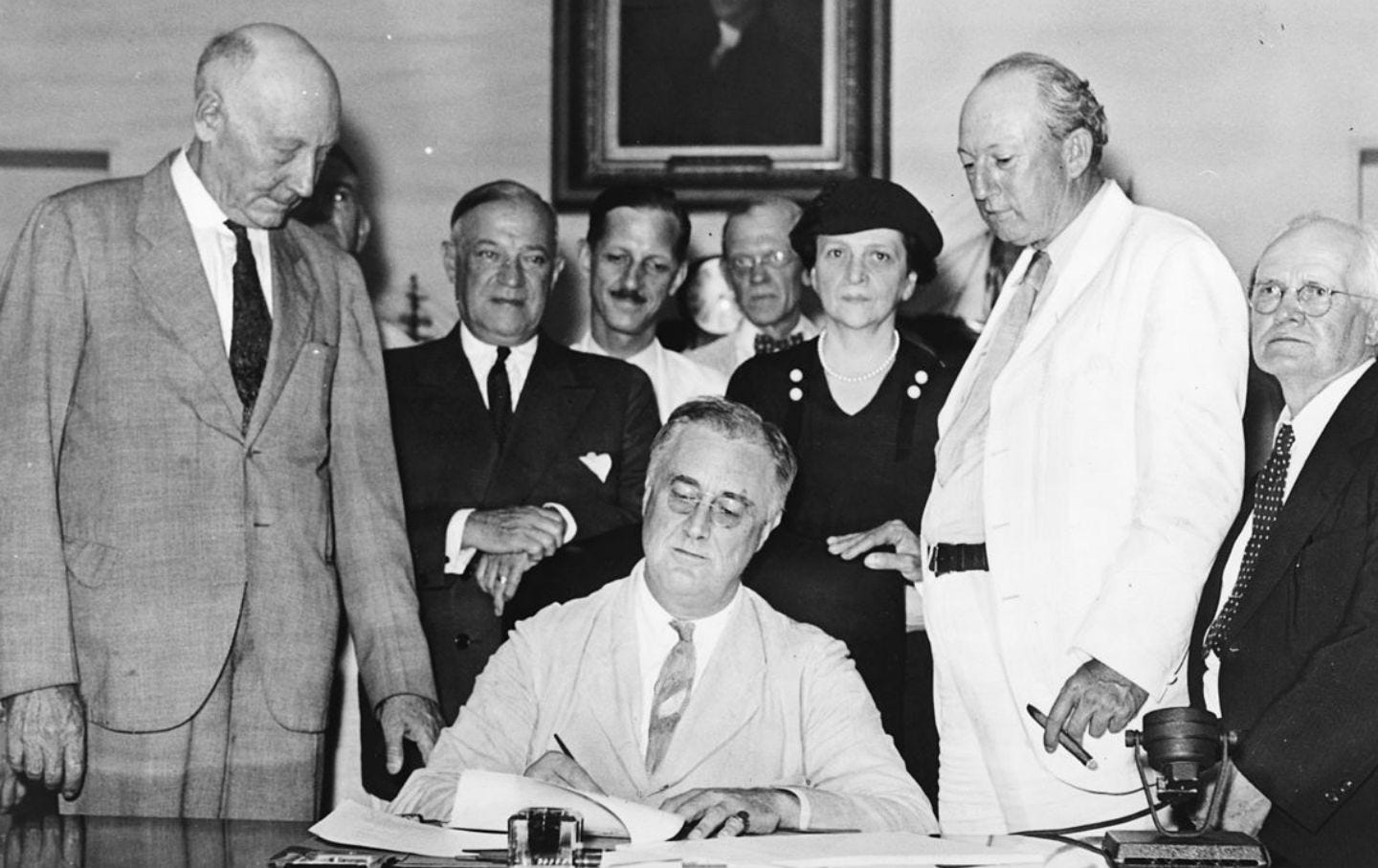
Social Security Act (August 14, 1935)
The crown jewel of 1935 was the Social Security Act, which created:
Old-age pensions
Unemployment insurance
Aid to dependent children and the disabled
This marked the first national social insurance system in the U.S.—a radical departure from the 19th-century idea that retirement and relief were entirely personal responsibilities.
Professor Leon Briggs of Defined Benefits notes:
“Social Security wasn’t just a program—it was a promise. The federal government would now stand with citizens at life’s hardest moments.”
The act was limited at first—many agricultural and domestic workers (including most Black and Latino Americans) were excluded. But it laid the foundation for a modern welfare state.
Wagner Act (July 5, 1935)
Officially called the National Labor Relations Act, the Wagner Act guaranteed:
The right of workers to unionize
Protection from unfair labor practices
Creation of the National Labor Relations Board (NLRB)
After years of strikes, unrest, and broken unions, this was a monumental shift. Organized labor now had federal backing. Membership in unions would triple by the end of the decade.
This was seen by many as Roosevelt siding with labor over business. It triggered fierce opposition from corporate leaders and conservative politicians.
Works Progress Administration (WPA)
Launched in May 1935, the WPA became the largest New Deal jobs program:
Employed over 8 million Americans through its lifespan
Built roads, bridges, schools, post offices, and parks
Hired artists, writers, and performers through the Federal Art, Writers, and Theater Projects
WPA projects reached every state, transforming American infrastructure and culture.
Dr. Markov writes:
“The WPA showed what democracy can build when fear is replaced by imagination.”
Resettlement Administration and Rural Aid
To address rural poverty and Dust Bowl displacement, the Resettlement Administration (RA) was created to:
Relocate struggling families
Provide loans for farmland
Develop planned communities with modern infrastructure
The results were mixed. Many farmers resisted relocation, and others criticized the paternalism of federal planning. But for thousands, it provided homes, dignity, and relief.
In the Southern Plains, the Dust Bowl raged on—1935 saw “Black Sunday,” one of the worst dust storms in U.S. history. This deepened the urgency of soil conservation, leading to expanded funding for the Soil Conservation Service.
Opposition from All Sides
1935 was also the year the New Deal came under serious political attack—from both the left and the right.
On the left, populist leaders demanded bolder redistribution:
Huey Long launched the “Share Our Wealth” movement, calling for caps on personal fortunes and guaranteed incomes.
Father Charles Coughlin, a Catholic priest with a nationwide radio show, criticized Roosevelt’s ties to bankers and called for monetary reform.
Dr. Francis Townsend pushed for a national pension plan even more generous than Social Security.
On the right, business leaders accused Roosevelt of creeping socialism. The American Liberty League, backed by DuPont and other industrial giants, called the New Deal unconstitutional and anti-business.
Roosevelt, however, stood firm—positioning himself as the defender of “the forgotten man.” In one of his most famous 1935 speeches, he declared:
“They are unanimous in their hate for me—and I welcome their hatred.”
This fiery populism resonated deeply with a public weary of elites and economic chaos.
Race, Gender, and the New Deal
1935 saw some improvements for marginalized groups, but deep inequities remained.
Black Americans gained jobs through the WPA and CCC, but often received lower pay or were excluded by local officials.
Eleanor Roosevelt began advocating more publicly for civil rights, meeting with Black leaders and pushing for anti-lynching laws (which would ultimately stall in Congress).
Native Americans continued to benefit from the Indian Reorganization Act, which returned tribal governance and ended forced assimilation.
Women, though largely excluded from manual labor programs, found work in WPA sewing rooms, schools, and administrative roles.
Frances Perkins, the first female Cabinet member (Secretary of Labor), played a central role in crafting Social Security and labor protections—quietly expanding women’s presence in federal policymaking.
Culture and Morale
The cultural branch of the WPA came alive in 1935. It funded:
Murals in post offices and schools
Oral histories from formerly enslaved people
The Federal Theatre Project, which staged Shakespeare and contemporary drama alike
This democratization of the arts was unprecedented. Ordinary Americans, even in remote towns, saw their stories reflected and dignity affirmed.
Meanwhile, radio remained the dominant media—with Roosevelt’s Fireside Chats continuing to calm, inform, and inspire the public.
Economic Trends
Despite the massive government spending, recovery remained slow in 1935:
Unemployment hovered around 20%
Business investment was still cautious
The stock market improved modestly, but volatility remained
Still, deflation had stopped, wages began to rise, and relief checks reached more homes than ever before.
The nation was not yet thriving—but it had stopped collapsing.
Conclusion: 1935 – The Blueprint for Modern America
1935 was not just a legislative year—it was a year of vision. Roosevelt and the New Deal shifted from crisis response to system-building. Social Security, labor protections, public arts, and rural development were not temporary band-aids—they were foundational institutions.
As Professor Briggs writes:
“1935 was the year the New Deal became something more than a reaction. It became an idea—of what government could be, and who it should serve.”
The economy remained fragile, and many groups were still excluded. But the groundwork for middle-class security, labor empowerment, and federal responsibility had been laid.
In that sense, 1935 wasn't just a chapter of the Great Depression—it was the beginning of a different kind of America.