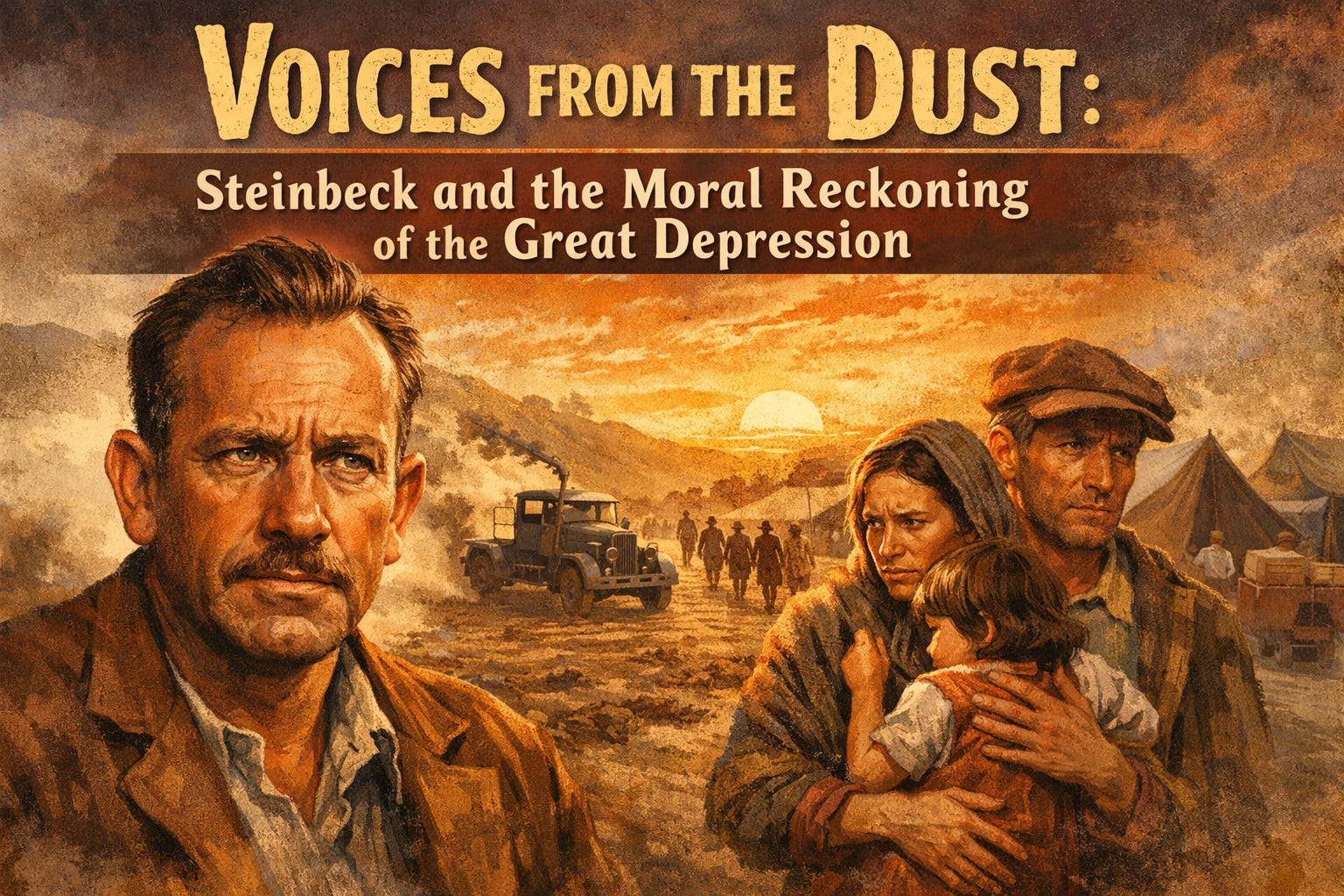
John Steinbeck emerged during the Great Depression as one of the most influential American writers to chronicle the lives of ordinary people battered by economic collapse. Writing from California, he witnessed firsthand the upheaval caused by drought, unemployment, and mass migration. Rather than focusing on abstract economics, Steinbeck centered his work on human experience. His fiction transformed statistics into stories that readers could feel.
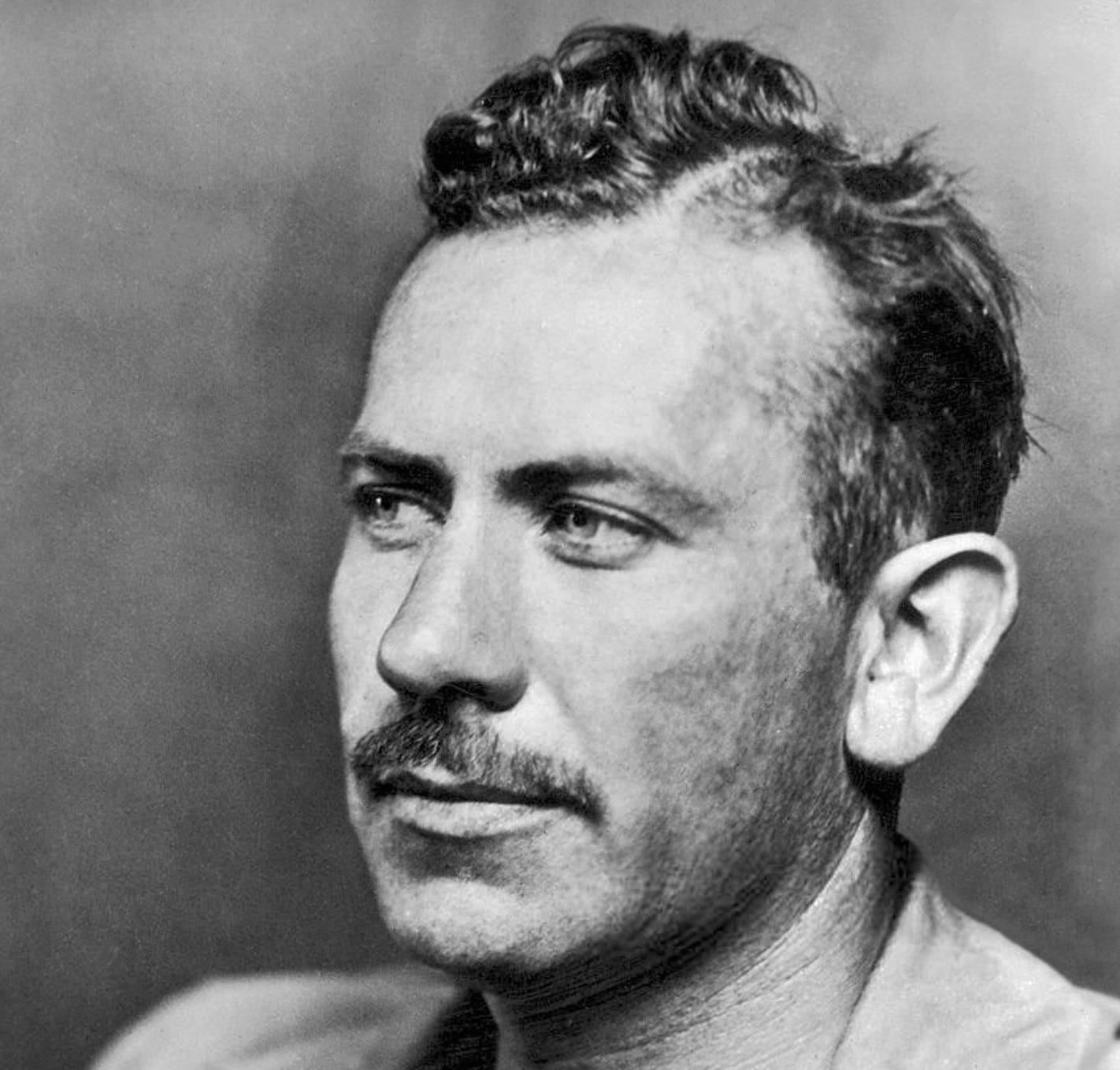
Steinbeck’s early life shaped his Depression-era perspective. Raised in Salinas Valley, he grew up among farmworkers, small farmers, and laborers whose livelihoods depended on fragile economic conditions. This proximity gave him an intimate understanding of rural poverty. It also instilled a lifelong commitment to portraying working-class Americans with dignity.
The Great Depression intensified inequalities already present in American society. Bank failures, foreclosures, and falling crop prices devastated rural communities. Steinbeck recognized that these forces were systemic rather than accidental. His writing consistently challenged the idea that suffering was the result of individual moral failure.
California became a focal point of Steinbeck’s Depression-era work. As Dust Bowl migrants poured west seeking jobs, they encountered hostility, exploitation, and broken promises. Steinbeck observed how abundance and poverty coexisted uneasily in the same landscapes. This contradiction fueled his critique of American capitalism.
Steinbeck’s journalism informed his fiction. He wrote investigative articles documenting migrant camps and labor abuses. These reports sharpened his sense of realism and urgency. They also convinced him that fiction could reach audiences in ways reportage alone could not.
His most famous Depression-era novel, The Grapes of Wrath, stands as a defining cultural document of the period. The book follows the Joad family as they flee Oklahoma for California. Their journey mirrors that of hundreds of thousands displaced by economic and environmental disaster. Through them, Steinbeck universalized the migrant experience.
The novel humanized Dust Bowl migrants at a time when they were often portrayed as threats or burdens. Steinbeck depicted them as families bound by loyalty, hope, and endurance. He emphasized their moral strength rather than their desperation. This portrayal challenged prevailing social prejudices.
Steinbeck also exposed structural injustice in Depression-era America. Banks appear as impersonal forces that evict families without accountability. Large agricultural interests exploit surplus labor to depress wages. The system itself becomes the antagonist, rather than any single villain.
Religion and moral philosophy play a central role in Steinbeck’s Depression writing. He questioned traditional notions of individual salvation and sin. Instead, he emphasized collective responsibility and shared humanity. Survival, in his view, depended on cooperation rather than competition.
The character of Jim Casy reflects Steinbeck’s evolving moral vision. Casy rejects organized religion in favor of a belief in human interconnectedness. His ideas echo Steinbeck’s broader critique of social fragmentation. During the Depression, such thinking carried both ethical and political weight.
Steinbeck’s prose style reinforced his themes. He alternated lyrical passages with stark, documentary-like chapters. This structure mirrored the tension between hope and hardship. It also allowed him to move fluidly between individual stories and national realities.
Public reaction to Steinbeck’s work was polarized. Many readers praised his compassion and honesty. Others accused him of exaggeration or political radicalism. The controversy underscored how threatening his message was to entrenched interests.
Despite criticism, Steinbeck’s Depression-era writing influenced public discourse. It shaped how Americans understood poverty, migration, and labor rights. The emotional power of his narratives made social issues harder to ignore. Literature became a vehicle for moral reckoning.
Steinbeck did not romanticize suffering. His characters endure hunger, humiliation, and violence. Yet he consistently affirmed their humanity. This balance prevented his work from becoming either sentimental or cynical.
The Great Depression forced Americans to reconsider the meaning of the American Dream. Steinbeck portrayed that dream as fragile but not meaningless. It survived not in wealth, but in solidarity and perseverance. His vision reframed success as communal rather than individual.
Steinbeck’s focus on families highlighted the social cost of economic collapse. Children, elders, and women bear disproportionate burdens in his stories. These perspectives broadened the conversation beyond male wage earners. The Depression is shown as a total social crisis.
His work also connected environmental disaster to economic injustice. Drought and soil erosion are not isolated natural events. They interact with poor land management and corporate agriculture. Steinbeck anticipated later environmental critiques.

Over time, Steinbeck’s Depression-era writing entered the American canon. Schools and universities adopted his novels as essential texts. They became reference points for understanding twentieth-century history. Literature and history merged in his storytelling.
Steinbeck’s legacy endures because the issues he explored persist. Economic displacement, migrant labor, and inequality remain relevant. His work continues to resonate during periods of crisis. Each generation finds new meaning in his Depression-era insights.
Ultimately, Steinbeck used the Great Depression to redefine empathy in American literature. He insisted that readers confront suffering they might prefer to ignore. By humanizing the marginalized, he expanded the moral imagination of his audience. His writing remains a testament to the power of storytelling in times of hardship.